
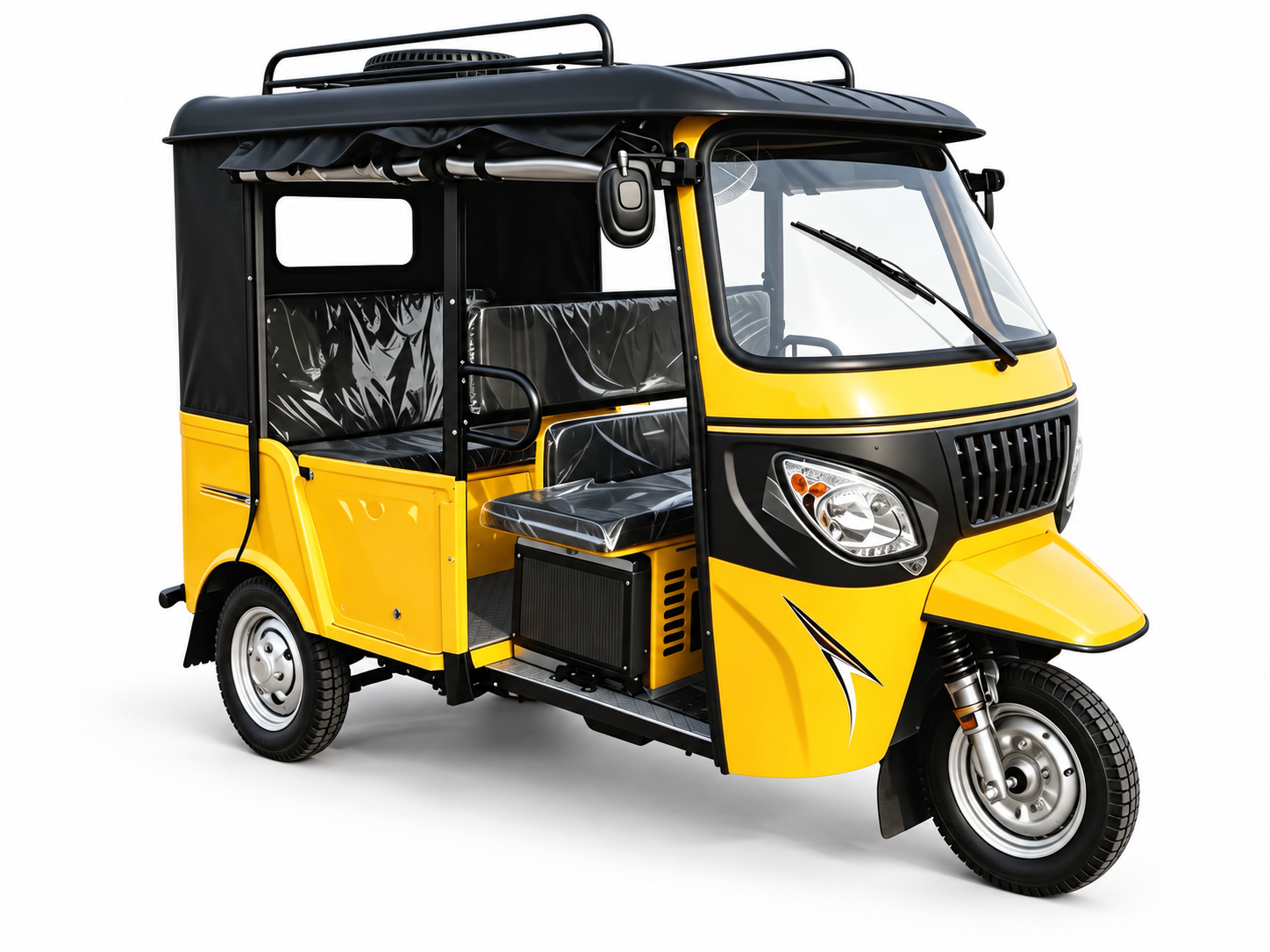
To work out what a tuk-tuk could earn on your route, count paid trips and average paying passengers, then subtract the day’s expenses. Include how much time the vehicle is available for work.
Before ordering for a neighbourhood route, hotel shuttle or campus service, record a typical working day. Daily kilometres, gradients, stops, passenger demand and time available for charging help you choose the configuration.
Safari 6 and Safari 9 guide prices
| Electric passenger tricycle | Guide price | Published passenger layout |
|---|---|---|
| Safari 6 | KSh 390,000 | 6 passengers |
| Safari 9 | KSh 410,000 | 9 passengers |
The price difference is KSh 20,000. Compare the seating and body layout with your passenger demand. Check the registered passenger capacity and permission for the intended service; a catalogue seating description does not establish approval for a public route.
The listings are for sourcing and import. Ask for a quotation that specifies the motor, battery chemistry and usable energy, charger, fitted equipment and delivery location. Include shipping, clearing, taxes and registration as separate inclusions or exclusions in the offer.
How much does charging an electric tuk-tuk cost?
Multiply the energy needed for your route by the billed charging rate. This example assumes 200 km a day, 8 kWh of battery energy per 100 km, 90% charging efficiency and an all-in electricity rate of KSh 25/kWh.
These are hypothetical planning inputs, not measured Safari 6 or Safari 9 performance. They produce 16 kWh of battery energy and approximately 17.78 billed kWh a day, costing about KSh 444.
Daily charging cost = daily km ÷ 100 × battery kWh per 100 km ÷ charging efficiency × billed rate.
At an assumed KSh 40/kWh, the same energy would cost about KSh 711. A petrol comparison using an assumed 25 km per litre and KSh 200 per litre would cost KSh 1,600 for 200 km. Replace all those inputs with your operating records and current prices before estimating savings.
For the applicable electricity account, ask Kenya Power about tariff eligibility and metering. Its June 2026 e-mobility announcement describes customer transition; the complete billed cost should be used in the route budget.
Battery cost and ownership questions
Ask for the battery’s chemistry, nominal voltage, usable energy and compatible charging equipment, along with its replacement price and warranty terms. If it is removable, check how to handle it and which spare packs or swapping services are supported.
Set aside money for battery repair or replacement as you drive. Divide the documented replacement budget by the distance you expect the battery to work to get a reserve per kilometre. If a provider owns the battery, use the lease, subscription or swap charges, and check the terms for ending the contract.
Ask what happens if a battery fault stops the vehicle. Who diagnoses it, is a replacement available, and how long could you be without the tricycle? Allow for the effect on fares and loan payments.
An example daily earnings budget
Suppose an operator completes 20 paid trips, averages four paying passengers per trip and collects KSh 30 from each passenger. Gross fares are 20 × 4 × 30 = KSh 2,400. Assume the total working distance, including unpaid movement, is 200 km.
The budget uses the earlier charging calculation and the daily allowances shown below. Fares, driver pay, finance and reserves are example amounts, not earnings claims or quoted rates for a Kenyan route.
| Item | Daily amount |
|---|---|
| Gross passenger fares | KSh 2,400 |
| Electricity | KSh 444 |
| Driver pay allowance | KSh 600 |
| Maintenance and tyres reserve | KSh 200 |
| Battery reserve | KSh 200 |
| Finance payment allowance | KSh 250 |
| Insurance and permits allowance | KSh 100 |
| Cash left after these items | About KSh 606 |
The example leaves about KSh 606 before any costs not shown, such as parking, depot rent, other taxes or an unexpected repair. Actual profit depends on your own income and expenses. If you drive the vehicle yourself, still allow for your labour when comparing the business with other work.
Passenger occupancy can change the result sharply
At the same fare and number of trips, one fewer paying passenger per trip removes KSh 600 from daily revenue. Holding the example expenses fixed gives these balances:
| Average paying passengers per trip | Gross fares | Cash left after example expenses |
|---|---|---|
| 3 | KSh 1,800 | About KSh 6 |
| 4 | KSh 2,400 | About KSh 606 |
| 5 | KSh 3,000 | About KSh 1,206 |
Load and service patterns can also change energy use and other costs. Record quieter periods as well as busy ones. Choose a nine-passenger layout for demand you can reasonably expect, within the approved operating configuration.
Plan charging around the next departure
The example needs about 17.8 billed kWh replaced during an eight-hour parking window, an average supply of about 2.2 kW. Ask the supplier whether the exact charger and battery can meet that schedule at your site.
Have a qualified installer assess the connection and the number of vehicles expected to charge together. EPRA’s charging and swapping guidelines cover site requirements in Kenya. A fleet also needs an operating plan for faults, a power interruption and vehicles arriving with less charge than expected.
CLEAR ANSWERS
Questions about electric tuk-tuk ownership
How much is an electric tuk-tuk from SafiVolt?
The Safari 6 guide price is KSh 390,000 and the Safari 9 is KSh 410,000 in the listings checked on 12 October 2026. Confirm the configured vehicle and the complete import and delivery scope in writing.
Which model will earn more?
Compare passenger demand, approved capacity, route suitability and expenses. A larger layout may carry more paying passengers on a busy service. Your revenue depends on how many of those seats are used.
How far will it travel on a charge?
Request a range specification for the supplied battery and the test conditions behind it. Then assess the tricycle at the passenger load, speed and gradients of your route. SafiVolt’s current Safari pages require the final battery and range to be confirmed in the quotation.